
August 17, 2026
Ötztal 2026 – Oetz: climbing, alpine hiking and our first via ferratas
Two summer visits to Ötztal filled with sport climbing, alpine hiking, a first via ferrata and an ascent of the 3,016-metre Sulzkogel.
Oetz as our base
This summer we travelled to Austria's Ötztal twice: first from 2 to 11 July, then again from 31 July to 7 August 2026.
We chose Oetz as our base and combined sport climbing with alpine hiking during both stays. On our second visit, we added via ferratas as well.
We discovered climbing later in life and have only been doing it for a short time. That makes us even more curious about where it can take us and what else we can learn. Our two stays in Ötztal were therefore not just holidays, but opportunities to gain more experience on rock and gradually discover new ways of moving through the mountains.
During our first visit, we stayed at Appartements Pfausler, Weiherweg 2, 6433 Oetz, booked through Booking.
We chose an apartment mainly for the privacy it offered and because we had our miniature schnauzer with us. The accommodation had very good guest reviews, and our experience fully confirmed them.
Oetz lies at an altitude of around 820 metres, below the Acherkogel massif and close to Lake Piburger See.
For us, it proved to be an excellent base. Within roughly 30 kilometres, it is possible to combine sport climbing, hiking, alpine tours, via ferratas, cycling, mountain biking and swimming. That makes it easy to adapt the programme to the weather and current conditions.
🧗 Climbing in Ötztal
During our stays, we climbed in two areas.
The first was Klettergarten Oetz, located practically at the entrance to Oetz and around one kilometre from our accommodation. It is a smaller area with approximately 39 very well-protected routes graded 3–7 UIAA.
One major advantage is the easy access. The car park is right by the area, and the walk to the rock takes about two minutes.
The second area we visited was Klettergarten Oberried, around 15 kilometres deeper into the valley. The drive from Oetz takes approximately 15–20 minutes, followed by a walk of only 2–5 minutes.
Oberried is considerably larger and offers around 143 sport routes graded 3–8 UIAA. We were also very satisfied with the quality of the protection there.
Climbing opportunities throughout Ötztal are far more extensive. Along the valley there are approximately 21 climbing gardens with around 750 routes of different grades.
Topos for the individual areas and further information about climbing, hiking and via ferratas are available on the Ötztal tourism website.
Klettergarten Oetz worked so well for us that we returned there twice during our second stay.
Alpine hiking with a dog and Stuibenfall
🥾 Alpine hiking with a dog
We brought our miniature schnauzer, weighing approximately 9 kilograms, on our first trip.
We usually prepare the routes that interest us at home using Mapy.com and Komoot. Once there, we fine-tune our plans according to the current weather and conditions.
We completed several hikes with elevation gains of approximately 500 to 1,200 metres and reached altitudes of around 2,400 metres.
One ascent started at the lower Acherkogelbahn station and led towards Acherbergalm, gaining more than 1,100 vertical metres.
Another beautiful tour was Ochsengarten – Rosskopf, with an elevation gain of approximately 890 metres.
We do not use cable cars on our hikes. If we are heading up a mountain, we want to walk the whole way.
For those who do want to use the lifts, the Summer Card is an interesting option. It is available from participating accommodation providers and includes many local attractions, including cable cars.
💦 Stuibenfall
One of our most technically interesting trips followed the route around Stuibenfall, the highest waterfall in Tyrol.
The waterfall is 159 metres high, and the hiking route follows an extensive system of metal stairs, walkways and viewing platforms. One of its main attractions is an approximately 80-metre suspension bridge.
This was where we had to think carefully about our four-legged companion. Metal grating on the stairs and bridge is not particularly suitable for a dog's paws.
We had prepared for situations like this. We carried our dog in a special backpack across the staircases, bridge and other exposed parts of our hikes.
There is also a grade C via ferrata around Stuibenfall, including a cable bridge across the waterfall in its upper section.
We left that one for another time.
Back in Oetz – via ferrata and Sulzkogel
We returned to Oetz at the turn of July and August.
This time we travelled without our dog, so we could choose more demanding mountain tours and add via ferratas to our climbing plans.
Because we had only been climbing for a short time and had no experience on more exposed alpine via ferratas, we did not yet know how comfortable we would feel moving at greater heights.
We therefore decided to progress gradually and chose an easier via ferrata first.
🧗 Eckkamm – our first alpine via ferrata
We selected the Eckkamm Klettersteig near Längenfeld, approximately 26 kilometres from Oetz.
The route has a maximum grade of B/C and is equipped with many artificial steps, making it suitable for beginners.
We completed it without difficulty and, most importantly, enjoyed it. It offered beautiful views and our first opportunity to discover how this style of movement in an alpine environment suited us.
The first experience went well, and it certainly will not remain our only via ferrata.
🏔️ Sulzkogel – 3,016 m
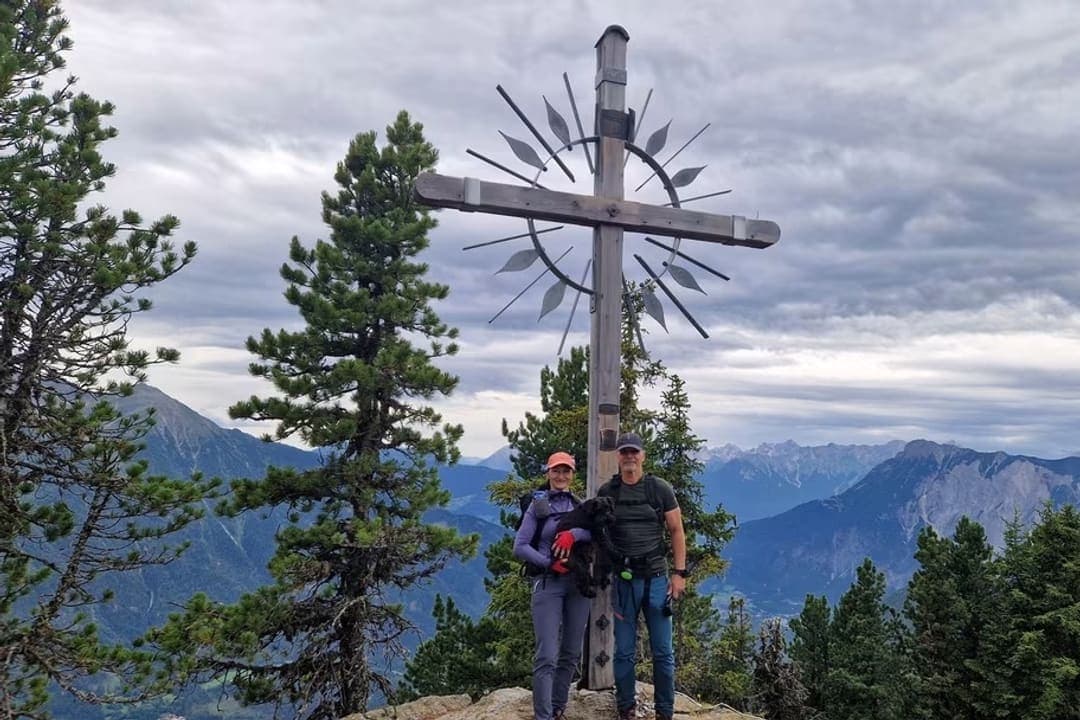
The most demanding hike of our second stay was the ascent from Kühtai to Sulzkogel (3,016 m).
We faced an elevation gain of approximately 1,200 metres and the opportunity to experience a longer period above 3,000 metres.
We completed the ascent, and Sulzkogel became one of the strongest experiences of the entire trip.
After climbing and our first via ferrata, we could now add a 3,000-metre summit as well.
⛈️ The weather changed our plans
It was genuinely hot during our first visit. Temperatures in Oetz hovered around 30 °C, and even in the mountains it was not much cooler during that heatwave.
Our second stay was more complicated to plan.
In addition to the high temperatures, showers and thunderstorms were forecast almost every day. The expected arrival time also changed frequently throughout the day.
We therefore had to adjust our programme continuously. We cancelled some planned activities, especially additional via ferratas, or replaced them with hiking. On two occasions, we went climbing at Klettergarten Oetz instead.
In the mountains, not everything can be planned. Sometimes it is better to change the plan and leave another objective for next time.
It is never too late to try something new
🍲 We keep food simple
We cannot offer much advice about local gastronomy.
During hikes and climbing days, dried meat, energy bars and fruit are usually enough for us.
Even after returning, we do not want to spend too much time preparing food. We mostly visit restaurants only for coffee and apple strudel.
Travellunch dehydrated meals have worked well for us. Just add hot water, wait ten minutes and they are ready.
For us, it is a simple and practical solution. We would rather spend our time in the mountains than cooking.
👍 Good news for alpine hiking enthusiasts
Ötztal is, of course, a well-known tourist area, and there are plenty of visitors around the main attractions and in the valley.
Our experience on the mountain routes was completely different.
As soon as we started climbing properly uphill, the number of people dropped very quickly.
On some routes, we met very few other hikers. Anyone looking for longer tours, greater elevation gains and a little peace will find that Ötztal has a great deal to offer.
After two visits in one summer, we can say that Oetz suited us perfectly as a base for an active stay.
Within a relatively small area, we could combine climbing, alpine hiking, via ferratas and other activities according to the weather. Even after spending more than two weeks there in total, we came nowhere close to exhausting everything Ötztal offers.
We discovered climbing later in life and have only been doing it for a short time. Perhaps our experience can inspire others who think it is already too late to start climbing or try new mountain activities.
There is no need to begin at twenty. What matters is starting sensibly, gaining experience gradually and enjoying the movement.
So far, we have progressed from our first climbing experiences to trips to the Alps, a first via ferrata, longer mountain tours and the 3,016-metre Sulzkogel.
We do not see it as a chase for performance. It is a way to keep discovering something new and enjoy time together in the mountains.
There are still plenty of places in Ötztal waiting for us next time.
Miloš and Jana Baumgartl